11/06/2026
Why Baseball Is the Hardest High School Sport to Stream
Short answer: baseball is the hardest high school sport to stream because everything a camera crew relies on is in the wrong place. The field is huge, the ball is tiny, the action comes in short bursts with long pauses between them, and the scoreboard is often out past the outfield fence. None of it is impossible. It just means baseball is the sport you plan for, not the one you wing.
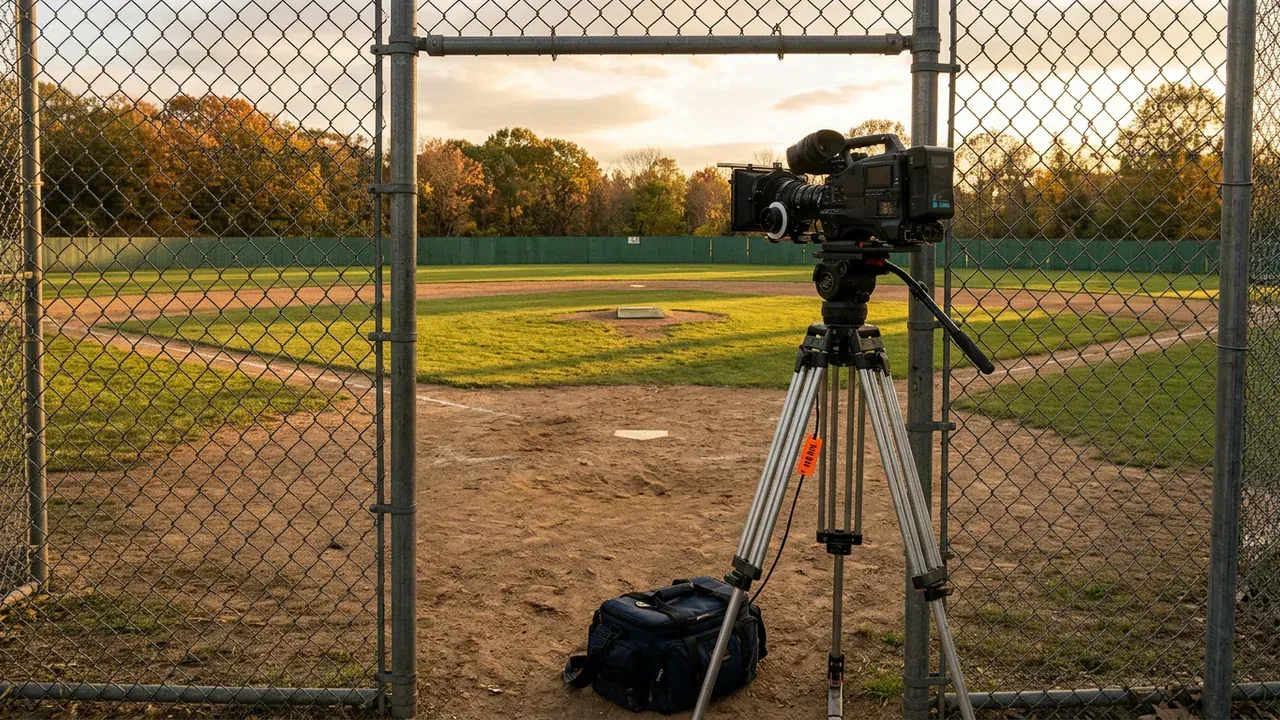
When we laid out our student broadcast program, we had to answer which sport takes the most effort to cover. Aaron Belchamber, who has worked in broadcast TV since 1997, answered in one line: "Probably baseball would be toughest." Aaron has been personally involved in live streaming events, high school sports among them. What follows is planning advice built from the shape of the field and from how the tools work, not a recap of a baseball season. It covers why baseball is hard, and what a student crew can do about it.
How baseball compares with the sports crews start on
Most crews learn on basketball or football, and the habits they build there are exactly the ones baseball punishes.
| Basketball | Football | Baseball and softball | |
|---|---|---|---|
| Where it is played | Indoors, close to the school network | A stadium, usually with a press box | A field that is often away from the main building |
| What the camera follows | A big ball on a small court | A crowd of players moving together | A small, fast ball that can go anywhere, including straight up |
| Pace | Nearly constant | Plays with short breaks | Short bursts with long pauses |
| Where the score is | On the wall, in view of the scorer's table | On a board the press box can usually see | Often beyond the outfield, far from the crew |
| The graphic viewers need | Score, clock, period | Score, clock, down and distance | Score, inning, count, outs, runners on base |
The field is enormous
The bases are 90 feet apart on a high school baseball field, so second base alone is about 127 feet from home plate, and center field is a long way past that. A softball field is smaller, but the center-field camera is still a long cable run from home.
That distance creates three problems at once:
- The network. Ball fields are usually far from the school's network. Test the connection at the field, at game time, before the first game.
- The cable. A center-field camera needs a wireless video link or a long cable back to the computer. Plan which one before the season, not on the day.
- Power. Bring enough battery for a doubleheader, or confirm an outlet at every camera position.
How much connection the field needs
YouTube's live encoder settings page lists the bitrates it wants, and it says to test before going live. Its H.264 numbers:
| Stream | Minimum | Recommended |
|---|---|---|
| 720p at 30 frames a second | 3 Mbps | 8 Mbps |
| 1080p at 30 frames a second | 5 Mbps | 14 Mbps |
| 1080p at 60 frames a second | 6 Mbps | 17 Mbps |
So if a speed test at the camera position shows 4 Mbps of upload, 720p fits and 1080p's 5 Mbps minimum does not. A steady 720p beats a sharp stream that keeps freezing. Test at game time, because that is when the field's signal is busiest.
Veo's baseball streaming guide says most baseball fields do not have Wi-Fi and lists the three ways to get online:
| Connection | What to know |
|---|---|
| A SIM in the camera or encoder | Veo calls it the most reliable, since the stream competes with no other device |
| A phone hotspot | Put the phone next to the camera. Veo warns that hotspot rates on shared phone plans can be throttled |
| The school's field Wi-Fi | Some high school facilities have it. Test the speed at the camera position, not in the parking lot |
Following a ball you cannot see
A baseball is small, white and fast, which is a list of everything a camera hates. Worse, the most exciting moment of the game, a fly ball, sends it into a bright sky, where the outfielder and the camera operator can lose it together.
The answer is not a better camera operator. It is a better place to stand:
- Main camera behind home plate, high above the backstop, wide enough to see the whole infield. Viewers forgive a wide shot. They do not forgive a shot of empty grass while a run scores.
- Set focus by hand. Automatic focus loves the backstop net and will lock onto it instead of the game.
- A second camera in center field, looking in at the pitcher and batter, gives the shot viewers expect from televised baseball. ScoreBird's high school baseball streaming guide says that lens needs at least a 200mm-equivalent zoom, and that one elevated camera behind home plate or in the press box covers about 95% of the action. Those are a scoreboard vendor's figures, so check them against your own field before you spend on a second camera.
- Cut on the pitch, not the hit. Stay on center field for each pitch, and go back to home plate once the ball is put in play.
- Put every camera and the computer behind a net or fence. Foul balls break equipment, and they are not sorry about it.
One more for the planner: check where the afternoon sun will be by the seventh inning, and keep it behind the cameras rather than in the lenses.
Keeping viewers through the dead time
Baseball has plenty of action. It is just spread very thin. Between pitches, between batters and between innings, a stream with nothing on screen but a pitcher staring at a catcher is a stream people close.
A student crew fills that time with information rather than noise:
- Show the count, outs and runners after every pitch. It is the single graphic that tells a viewer joining late what is going on.
- Ask each dugout for a lineup card and a pitch counter. Your graphics operator and announcers will have something accurate to say about every batter.
- Use student announcers. A headset and a seat with a view of the field are enough, and the pauses in baseball give them room to talk that basketball never does.
- Have a holding graphic ready for a rain delay. Keep the stream running, put the graphic up, and cover the equipment first.
The score problem, and how High Score Live handles it
High Score Live is our scoreboard app for volunteer crews: a phone or webcam watches the scoreboard, the app reads it, and a clean score graphic goes into OBS Studio, vMix live production software or any streaming software with a browser source. It works with baseball and softball, with innings in place of quarters and scoring buttons for one to four runs on a play.
Baseball makes the scoreboard harder in two ways, and it helps to know both before game day. One limit first: High Score Live's published feature list covers scores, clock and period, which in baseball means the inning. Treat the count, outs and runners as your graphics operator's job until we say otherwise. If your crew needs them on screen this season, the next section compares what else exists.
If you need the count and outs on screen this season
ScoreBird's baseball guide says its overlay shows the score, the inning with a top or bottom marker, and the ball, strike and out count, fed by its NeST device at the scoreboard controller. The guide names Daktronics, Nevco, Fair-Play and Electro-Mech boards as supported, and says a board without a data port can use ScoreBuddy, its app for entering the score by hand. We found no prices on the ScoreBird pages we read, and it is a vendor describing its own product.
| Your field | Option for the count and outs |
|---|---|
| The board has a controller a data device supports | A data device such as NeST, after checking the board with ScoreBird's free compatibility checker |
| The board has no data port, or there is no board | Hand entry on a phone or tablet, or your graphics operator |
| A 7-segment LED board and nobody to spare | High Score Live for the score and inning, with the count done by hand |
The board is far away
The camera reading the scoreboard has to see it clearly and sit on the same Wi-Fi network as the computer running High Score Live. At a gym that is easy. At a ball field, it can mean a phone on a tripod a long way from the press box, so check the network reaches that spot.
Not every board can be read
Automatic reading needs a 7-segment LED scoreboard. Dot-matrix, LCD and video-wall boards cannot be read. If your field's board is one of those, or there is no board at all, an operator can run the whole game by hand from the dashboard, which is still easier than typing a score into streaming software between pitches.
High Score Live also saves an instant replay on every score, which gives a baseball crew something to show in the pause after a run crosses the plate.
It is in final testing now and not on sale yet. So far it has been tested on recorded football footage, not at a ball field. People on the High Score Live early-access list are the first we invite to try it, with fifty dollars off.
A starter shot list for your first game
Start with one camera and add the second once the crew is confident. Here is how the jobs split:
| Position | What it shows | When it is on air |
|---|---|---|
| Behind home plate, high | The whole infield, wide | Every ball in play, and the default shot |
| Center field | Pitcher and batter, from behind the pitcher | Every pitch |
| Scoreboard camera | The board, for High Score Live or your graphics operator | Never on air: it feeds the score graphic |
| Holding graphic | School logo, score and "We'll be right back" | Rain delays and technical trouble |
Go live about ten minutes before the first pitch, so families finding the link are not met with an error.
If you pick baseball or softball in our free Program Blueprint questionnaire, your preview includes a note on where to start, and the full Blueprint adds a baseball and softball guide covering camera positions, network and power, and what to do during the game. Want someone at the field with your crew for its first few games, in Florida or southeast Georgia? Contact Next Day Videos and tell us which field you are working with.
Researched and drafted with AI, then reviewed and edited by the site's editors.