11/17/2026
We Know Why Your Video Didn't Work
Short answer: a business video usually fails in one of five places: nobody presses play, viewers leave in the opening, viewers leave in the middle, viewers finish and do nothing, or the video was cut for the wrong screen. Your viewing numbers show which one. The fix is then usually a re-cut, a re-mix or a new last ten seconds, not a remake. Below is how we read a video that is not working, with three commands that measure the sound, the shape and the opening instead of guessing.
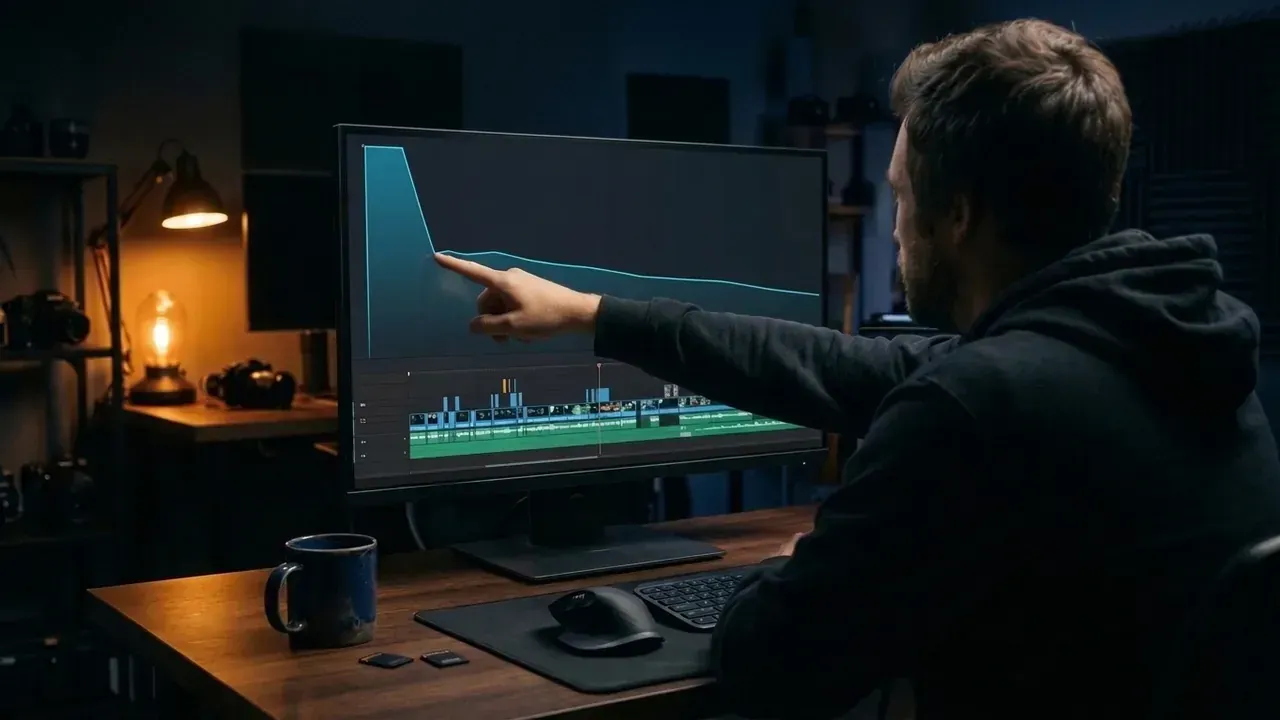
Start with where viewers leave
YouTube's audience retention report is video-level only. In YouTube Studio, open Content, pick the video, open its Analytics and look for Audience retention on the Overview or Engagement tab. It shows an intro figure, the share still watching after the first 30 seconds, plus dips (viewers skipping or leaving) and spikes (parts watched again). Clicking "See more" compares your video with others of similar length.
One limit to know: YouTube's page says a high intro figure could mean the opening matched the thumbnail and title, but it does not say what a low one means. The causes in the table below are our judgment, not YouTube's.
| What the numbers show | Most likely cause (our judgment) | What we check | Typical fix |
|---|---|---|---|
| Few plays from people who saw it | Title, thumbnail or placement | Does the video match what the title promised? | New title and thumbnail; move it to a page people visit |
| Steep drop in the first 30 seconds | Weak hook or bad audio | First 5 seconds with sound off, then sound only | Cut the lead-in; re-mix the audio |
| Steady slide, or a dip in the middle | No arc, pacing, wrong length | Scene-by-scene outline | Re-order and trim; replace generic shots |
| Most watch to the end, nobody acts | Missing or buried ask | The last 15 seconds | One spoken and shown ask; a link that works |
| Fine on a laptop, poor on a phone | Platform fit, captions | Watch on a phone, muted | Re-frame; add captions |
Measure it: three commands
All three use FFmpeg, a free command-line tool. We ran each on a 12-second test clip to confirm the output below; run them on yours.
| Question | Command | What it prints |
|---|---|---|
| How loud is it? | ffmpeg -hide_banner -nostats -i video.mp4 -filter_complex ebur128=peak=true -f null - |
A summary with Integrated loudness (LUFS), Loudness range (LU) and True peak |
| Which shape is it? | ffprobe -v error -select_streams v:0 -show_entries stream=width,height,duration -of csv=p=0 video.mp4 |
1280,720,12.000000: width, height, seconds |
| What do the first ten seconds look like? | ffmpeg -i video.mp4 -vf "fps=1,scale=320:-1,tile=5x2" -frames:v 1 sheet.png |
One image, ten frames, one per second |
Run the first on every video in a series, not one. The European Broadcasting Union's R 128 sets a broadcast target of -23.0 LUFS with a tolerance of 0.5 LU and a true peak no higher than -1 dBTP. It also says peak normalization has caused considerable loudness differences between programs, and that those inconsistencies cause the most viewer complaints. Online platforms use their own targets, so treat -23 as a reference, and treat the spread between your videos as the real finding.
If width is larger than height, the file is landscape. On a phone feed that means black bars, which is the common mistake in the platform table below.
The opening: hook and audio
The hook
A hook is the first few seconds telling a stranger who the video is for and what they get. Template-built videos often open with a logo sting, a slow aerial or "Welcome to...", none of which answers that. Make the contact sheet, then check each frame: can you say what this video is about from the first four frames? If not, a stranger cannot either.
The fix is almost always subtraction. Cut to the point, move the logo to the end and open on the thing the viewer came for.
The audio
Sound problems feel like boredom: viewers leave without knowing why. We listen for three things: a music bed that fights the voice, a voice that changes level from one clip to the next, and room noise or echo. A mix can fix the first two. Room noise on a voiceover is usually cheaper to re-record than to repair.
Pacing and length: the arc
Dips in the middle usually mean nothing in the video builds. This is the typical failure of a video assembled from stock footage and a music bed: every shot is pleasant and interchangeable, so the viewer has no reason to wait for the next one.
Our rule of thumb, a judgment and not a standard: write the video as one sentence per scene. If you can shuffle the scenes and no one would notice, there is no arc. A working structure is a problem the viewer recognizes, proof that you solve it, and one thing to do next.
There is no magic length. Use the similar-length comparison to judge your video against its own kind. Cut what does not move the story forward and replace stock shots with footage of your own people, place and work.
Platform fit
YouTube's upload guidance calls 16:9 the standard on computers and says the player adapts to vertical and square videos. YouTube Shorts are short-form videos up to 3 minutes long, and vertical uploads are supported. A video made for a website hero and one made for a phone feed are different edits.
| Where it plays | What fits | Common mistake |
|---|---|---|
| A page on your own site | 16:9, embedded from YouTube, one video per page | Several videos on one page, none findable |
| A phone feed or Shorts | Vertical, the point inside the first seconds, captions on | A widescreen file with black bars |
| An email or ad | A short cut-down with one ask | The full-length video, hoping they stay |
We cover why to embed from YouTube and why each video should get its own page. A video buried in a slider is a video nobody was sent to.
Captions
The W3C's Understanding Success Criterion 1.2.2 explains the Level A requirement in the Web Content Accessibility Guidelines for captions on prerecorded video with sound; its stated aim is to let people who are deaf or hard of hearing watch. Captions also serve anyone with the sound off, who otherwise gets a silent slideshow.
Auto-generated captions are a draft. Names, places and brands are where they go wrong, so someone reads them once before the video goes out. Our guide to captions on business videos has the checklist.
The call to action
On YouTube, end screens can be added to the last 5 to 20 seconds of a video, which must be at least 25 seconds long, with up to four elements on a 16:9 video. The Link element, which points to an outside website, is available only in the YouTube Partner Program. So if your ask is "visit our website", do not assume a clickable button will carry it. Put the address on screen, in the description and on the page the video sits on.
If most viewers finish and nothing happens, look at the last 15 seconds. The usual faults are three asks at once, an ask that is spoken but never shown, and a link that does not work where the video plays. The fix is one ask, said once, shown once.
A check that finds what nobody looked for
On 10/09/2026 Claude ran a frame check on Restoration Advertising's AI water-damage B-roll clips: ten frames per clip, one per second, the same idea as the contact sheet above. It found a kitchen clip showing "2 a.m." as on-screen text for about two seconds, though the prompt said no text, and partial lettering on a worker's sleeve in another clip.
The check had limits, and the review said so: ten small frames catch text and logos, not a distorted hand mid-motion, and it did not include listening to the audio. Our AI video checklist covers the other half. Review in passes, picture first, then sound alone.
What to send us
If you have a video that is not working, tell us about it through the contact form with the link and, if you have it, the retention graph. We will reply with what we would check first. You can also see how we work with Jacksonville businesses.
We have not published before-and-after results for rescued videos here, and we are not going to invent them. What you get on this page is the method.
Researched and drafted with AI, then reviewed and edited by the site's editors.