10/29/2026
What a Student Broadcast Program Really Costs
Short answer: a student broadcast program has two budgets, not one. The first is equipment, which the school buys and owns: by our own 2025 estimates, roughly $4,600 for a basic three-camera setup and over $20,000 for a five-camera one. The second is how much outside help you hire, from a $89 self-serve plan to an in-person launch from $5,000. They are separate decisions, and they are easy to mix up.
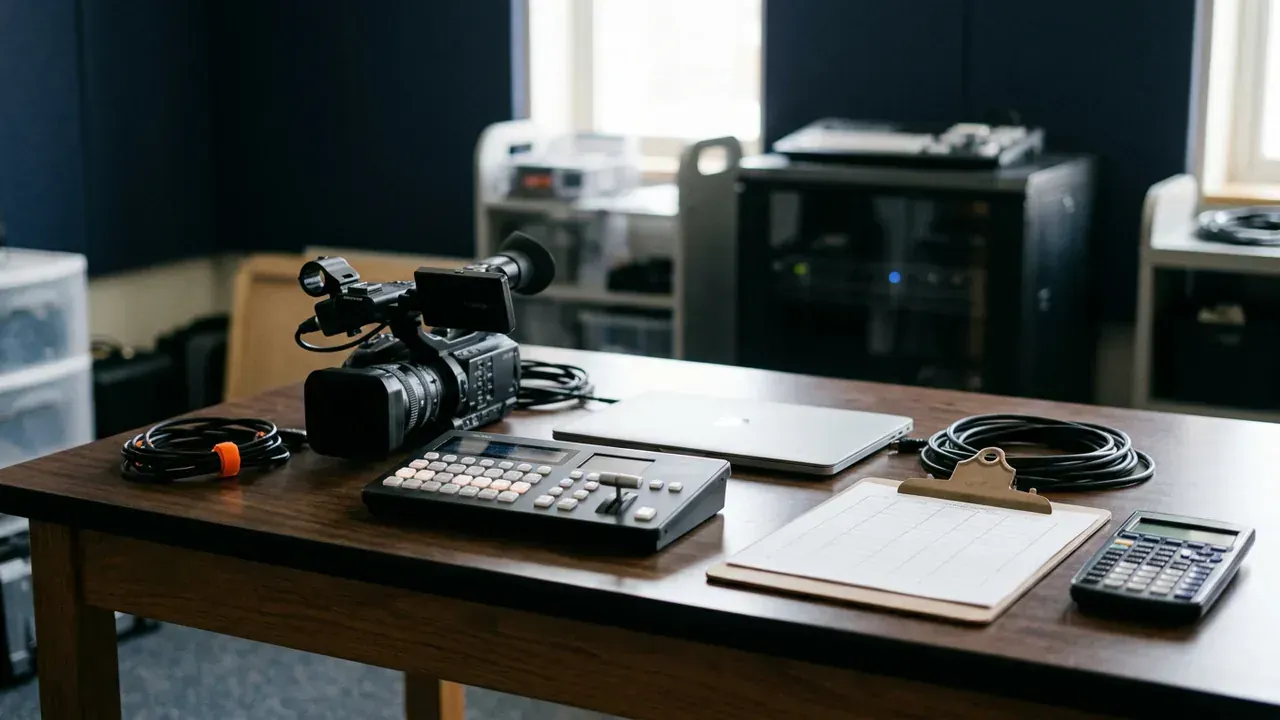
Two budgets, decided separately
A school with $40,000 for equipment may still want to do the rest itself. A school with $5,000 may need someone in the gym for its first few games. How much a school can spend on gear says nothing about how much help its staff needs to run it.
The trap is the second case. A generous equipment budget with nobody who has run a stream before buys gear that ends up in a storage closet.
Budget one: the equipment the school buys
These are the estimates on our student broadcast program page, based on 2025 average costs. Treat them as orders of magnitude to plan against, not a quote. Prices drift.
| Item | Estimated cost |
|---|---|
| A PC laptop to run the streaming software | $1,000 to $2,500 |
| Video capture card or device | $600 to $1,500 |
| 3 to 5 HD or 4K cameras | $500 to $2,500 each |
| Tripods and mounts | $200 to $400 each |
| 2 to 3 microphones and stands | $200 to $400 each |
| Monitors, cables, wireless transmitters and other hardware | $500 to $4,000 |
Added up at the low end with three cameras, that is about $4,600. At the high end with five cameras, it is about $23,700. Here is the arithmetic, with one tripod per camera:
| Low end | High end | |
|---|---|---|
| Cameras | 3 at $500 = $1,500 | 5 at $2,500 = $12,500 |
| Tripods | 3 at $200 = $600 | 5 at $400 = $2,000 |
| Microphones | 2 at $200 = $400 | 3 at $400 = $1,200 |
| Laptop | $1,000 | $2,500 |
| Capture device | $600 | $1,500 |
| Other hardware | $500 | $4,000 |
| Total | $4,600 | $23,700 |
Our plan sorts schools into three levels by that budget: Shoestring under $5,000, Mid-level from $5,000 to $15,000, and Top-level above $15,000. The build-out details page shows what each level looks like and the order to buy in.
Do those estimates still hold?
We compared them with the retailer listings recorded for the Program Blueprint in September 2026. They are listings, not quotes, and they move often.
| Item | Estimate above | Listings seen in September 2026 |
|---|---|---|
| Camcorder that meets our minimums | $500 to $2,500 each | About $750 to $1,700 |
| Fluid-head tripod | $200 to $400 each | About $160 to $200 |
| Dynamic microphone, before cable and stand | $200 to $400 each | About $110 |
| USB capture device, one camera | $600 to $1,500 | About $90 to $320 |
The tripod, microphone and capture listings came in under the estimate, and that roughly offsets camcorders that listed above the $500 low end. So $4,600 is plausible for a bare-minimum three-camera kit, but cameras are the line to watch.
Start smaller than the plan
A phone on a tripod with a clip-on microphone can stream a first event, enough to show the school and its sponsors what the program will be. And if your school streams on the NFHS Network, ask before you buy: its school FAQ says the Network provides the hardware for its Pixellot camera system, and that a student-run broadcast program can use the school's current equipment to stream to the Network.
Budget two: the help you hire
Next Day Videos' prices are for our help only. The school buys its own equipment; we tell it what to buy, where it goes and how it is set up, with no drilling or permanent installation.
| Package | What it includes | Price |
|---|---|---|
| Program Blueprint | A custom plan from a questionnaire: equipment in buying order, crew roles, a 12-week launch timeline and a Sponsor Kit. Remote and self-serve | $89, credited toward the packages below if booked within a year |
| Guided Launch | The Blueprint, a review call, training and check-ins, and two live events with our seasoned broadcast talent coaching your student announcers | From $5,000, an estimate |
| Build & Train | Equipment guidance and set-up, training in every crew role, captioning included, five live events while students take over, and the Student Crew Training Handbook | From $10,000, an estimate |
Guided Launch and Build & Train cover Florida and southeast Georgia, with a travel fee for distant schools. The Blueprint works anywhere.
Add-ons, if you need more than the plan
- Basic Student Handbook, $199: a ready-made training guide for every crew role.
- Student Crew Training Handbook, $899: a curriculum written for your school's program and equipment.
- Hourly help, $125 an hour in 4-hour blocks of $500: planning calls, choosing equipment, set-up or crew training.
Which help fits your school
| Your situation | Where to start |
|---|---|
| A staff member has run a stream or edited video before | The Program Blueprint |
| Nobody has, but someone is willing to own it | Guided Launch |
| You want every crew role trained before you step back | Build & Train |
A Blueprint buyer needs one person with some video or livestream experience. Every school needs power and internet at the venue before anything else.
The costs that show up later
Two things go wrong more than any others, and both cost money after the fact. The first is the venue's internet: test the upload speed where you will stream, at the time of day you will stream, before buying anything. The second is event organizers who will not make room for a crew. Settle access before the first game, not during it.
Paying for it
Most schools have no budget line for this, and that is usually where the conversation stalls rather than ends. Local businesses fund exactly this kind of program, and Brandager's guide for a business weighing a sponsorship explains what they get out of it. Our free Sponsor Kit has the pitch letter, outreach scripts, sponsorship menu and agreement checklist to ask them.
Not sure which level or package fits? Get your free plan preview. It takes about twelve minutes and shows the equipment level that fits your budget on the spot.
Researched and drafted with AI, then reviewed and edited by the site's editors.