11/04/2026
What Equipment Does a School Need for a Student TV Studio?
Short answer: before a single camera, a student TV studio needs three things: power where the cameras stand, enough upload speed at the venue, and one adult who has run a stream. After that, the equipment scales to the budget. Under $5,000 buys one or two camcorders, a laptop and simple audio. $5,000 to $15,000 buys three camcorders, a hardware switcher, crew headsets and an audio mixer. Above $15,000 buys remote-controlled broadcast cameras and dedicated network and power at several venues. Whatever the level, buy audio before cameras.
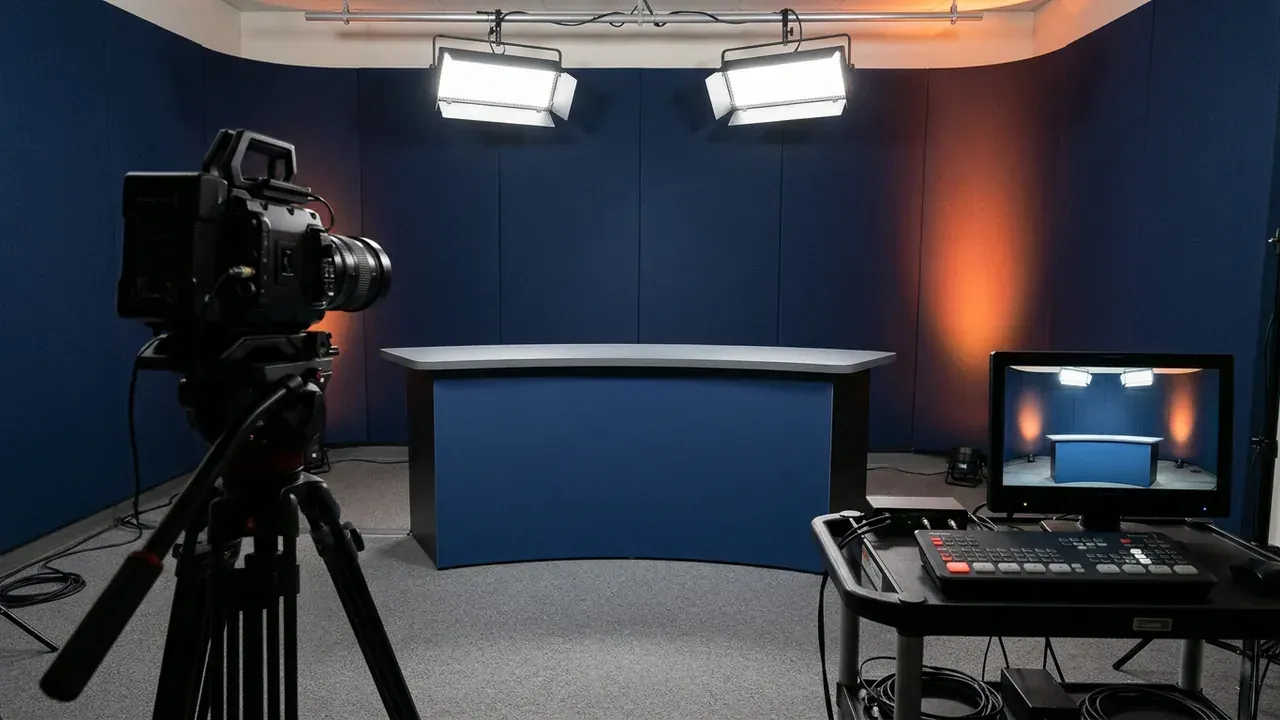
Most equipment lists for this question start with cameras. A program that outlives its first crew is one where the roles and the routine were designed before anything was bought, so this one starts with the venue.
The minimum: power, internet and someone who has run a stream
These are the three things a school has to have before anything is worth buying. Most other problems can be solved along the way; these three cannot be bought around.
- Power at the camera positions. Where there is no outlet, plan portable power stations at the production table and each powered camera, and ask facilities whether a circuit can be added before next season.
- Upload speed at the venue. Test it from the gym, press box or auditorium, not the front office, on the network the stream will use and at the time of day you will stream.
- Someone who has run a stream. Nobody on staff with that experience is a normal start, but it means budgeting time for training before the first event.
What the upload number means
YouTube's live encoder settings page lists the bitrates it wants for each picture size, and it is the clearest way to read a speed test. The numbers below are its H.264 columns.
| Stream | YouTube's minimum | YouTube's recommended |
|---|---|---|
| 720p at 30 frames a second | 3 Mbps | 8 Mbps |
| 1080p at 30 frames a second | 5 Mbps | 14 Mbps |
| 1080p at 60 frames a second | 6 Mbps | 17 Mbps |
That is why we tell schools that under 10 Mbps of upload holds 720p at best, and under about 5 Mbps will not hold a steady stream, whatever the cameras cost. No camera fixes a slow connection. If the number is low, ask district IT about a wired drop or a dedicated connection first, and ask early: approving streaming on a school network can be the slowest step of the whole launch.
Ask the NFHS Network before you buy cameras
The NFHS Network's school FAQ says the Network provides all the hardware for its Pixellot automated camera system, camera head, computer and scoring device included, and installs its cabling. It also says the Network will not install internet jacks, and that the school pays for additional materials and labor. If your school streams on the NFHS Network, or might, find out which cameras it has installed or would install, so you do not buy what it provides. The same FAQ says a school with a student-run broadcast program can use its current equipment to start streaming to the Network.
Three levels, in a sentence each
Our planner picks the level from one answer: the equipment budget for the first year. Experience, internet and staffing decide how much help a school needs, not how small a kit it gets.
| Level | Budget | What it buys | Enough for |
|---|---|---|---|
| Shoestring | Under $5,000 | One or two camcorders, a laptop and a simple audio setup | Your biggest events, morning announcements and real student roles from day one |
| Mid-level production house | $5,000 to $15,000 | Three camcorders, a hardware switcher with graphics, crew headsets and an audio mixer | Several sports and performances each season, run as a club or an elective |
| Top-level professional | $15,000 and up | Remote-controlled broadcast cameras, a production switcher with replay and graphics, and dedicated network and power at several venues | A public audience across the school's venues, with live switching and ISO recording |
The build-out details page describes what each level lets a department do.
Why only one or two camcorders under $5,000? The three camcorders we researched for school buyers, ones that record for hours on wall power with a clean video output, listed from about $750 to $1,700 in September 2026. Prices change, but these were accurate when this was published. At the middle of that range, about $1,225, three camcorders alone cost about $3,700, which leaves little of $5,000 for a laptop, capture and audio.
The order to buy in
Equipment is the fourth decision, not the first. Before it come what you want to cover, which staff member owns the program, and which student roles you need. Then:
- Fix the venue first. Internet, power and district IT approval, as above.
- List what you already own. Phones, tablets, a capable laptop, tripods, an old switcher or mixer: a school rarely starts from nothing, and buying a second of something is the easiest money to waste.
- Buy audio before cameras. A sharp picture with bad sound reads as amateur to every parent watching at home; a soft picture with clean sound does not. It is the cheapest quality you can buy, and the one most schools buy last.
- Buy cameras for your first event, not your biggest. Football draws the biggest crowd but is not the easiest first stream, so rehearse on a smaller home event. For baseball or softball, start with one camera behind home plate and add a center-field camera once the crew is confident.
- Add what lets a crew grow into it. Student announcers are a low-cost win: a headset and a seat with a view of the scoreboard or stage.
What to check on the label
| Item | Check before you buy |
|---|---|
| Camcorder | A camcorder, not a stills camera, since many stills cameras limit recording time or overheat. Clean HDMI output with the on-screen display turned off, 1080p at 60 frames a second, four hours or more of recording without stopping, wall power, 12x optical zoom or more |
| USB capture device | HDMI input, 1080p at 60 frames a second, works as a webcam with no driver to install. One per camera, each in a USB 3 port |
| Tripod | A fluid head for smooth pans, a payload of at least 3 kg (about 6.6 lb), tall enough to reach 150 cm (about 59 in) |
| Microphone | Dynamic, which rejects crowd noise better than a condenser, with an XLR output. Budget an XLR cable for each |
| Audio interface | Two or more XLR inputs, phantom power, USB audio to the computer |
The named products for your level, in order, with where each one goes, are in the Program Blueprint. Every price in that list is shown as approximate, with the date it was seen, and a product we are less sure of is marked as a suggestion to look into, with our rating for how well it fits and how sure we are of its price. Prices for this gear change often, sometimes daily, so a list that says how old its prices are is the honest kind.
What not to buy first
- A top-level kit for a team that has never streamed. The trap is a generous budget and nobody who has run a production: the gear arrives, and nobody knows how to run it.
- Cameras before the speed test. See the table above.
- Anything the NFHS Network might install for you. Ask first.
- Anything that needs drilling or permanent installation. When we help a school place and set up its equipment, it is with no drilling or permanent installation. A kit that moves can cover the gym on Friday and the auditorium on Tuesday, and a lockable room to store it in matters more than a fixed mount.
- Gear for a show you cannot stream. Musicals and plays need a streaming license for each show, and some titles cannot be streamed at all. Check before you promise a livestream.
Who trains the students
Equipment is the half that scales to a budget. The half that decides whether it is still used in two years is the crew: a director, camera operators, audio, graphics, a scoreboard operator, announcers and a caption editor, rotating so every student learns the whole pipeline. Our guide to starting a student-run broadcast program lays out those roles and why each one matters.
Next Day Videos builds these programs and then steps back so students run them. A school with someone who has run a stream can work from the Blueprint on its own. In Florida and southeast Georgia, we can also train the crew in person and run its first live events alongside the students while they take over.
If the money is the question, our free Sponsor Kit has the letters, scripts and agreement checklist to ask a local business to fund it.
Start with the free plan preview: about twelve minutes, and it shows the equipment level that fits your budget on the spot. Or tell us about your school and what you want to cover.
Researched and drafted with AI, then reviewed and edited by the site's editors.